


Anyone who wants to build a digital operating system for society cannot do so alone. Not because the technology isn’t up to the task – but because social infrastructure needs legitimacy: from academia, which provides methodological validation; from the government, which implements it; from the business sector, which builds upon it; from the legal community, which trusts it. And from the public, which understands why it matters.
This is the story behind Rulemapping’s efforts and activities over the past few months. The goal was to systematically build a coalition – one stakeholder group at a time, in their own spaces, with their own questions. And each of these encounters has brought “Law as Code” a step closer to what it is meant to become: the methodological foundation of the ecosystem for digitized law.
Academia: Methodology Needs Academic Anchoring
A methodology that aims to make law machine-readable in all its complexity must be able to stand up to the toughest tests. German tax law is one of them. That’s why the invitation to the LMUDigiTax Conference at Ludwig Maximilian University of Munich – the leading academic forum on digitization in tax law – was more than just a presentation. It was an opportunity to demonstrate to the most discerning audience of experts that rule mapping doesn’t stop at the simple cases.
Dr. Tilo Wendt didn’t bring theory to Munich. He presented a completed pilot project: in collaboration with the Federal Ministry of Finance, Rulemapping had converted Section 39b of the Income Tax Act (EStG) - the payroll tax withholding procedure with its multi-step calculation logic – into machine-readable decision logic and validated it with over three thousand automated test cases. In the subsequent panel discussion on the session “Update: Digital-Ready Legislation,” it became clear that the question in academic circles is no longer whether “Law as Code” works in tax law – but rather how it scales. The academic coalition is growing.
The Administration: Practice Needs Partners, Not Presentations
Academic legitimacy is one thing. Administrative practice is another. At the 12th Future Congress on Government & Administration at the bcc Berlin — with over two thousand industry professionals in attendance, the leading event for administrative modernization in the German-speaking world –the focus was not on persuasion, but on something more tangible: demonstrating that Law as Code can be integrated into existing system landscapes.
Dr. Dirk Woywod, together with Markus Dillmann from ServiceNow, led a best-practice dialogue on decision automation in complex end-to-end processes. The format relies on real-world questions rather than ready-made answers - and that precisely reflects the reality in which public administrations operate: with legacy IT structures, limited resources, and the pressure to deliver quickly. The message: Rule mapping doesn’t have to be a replacement, but rather a building block. Dr. Woywod elaborated on this connection a few weeks later at the ServiceNow Public Sector Summit in Berlin, where he presented the specific architecture of this integration to decision-makers in public administration.
At our own booth (B029) at the Zukunftskongress, theory turned into conversation: direct encounters with people who grapple daily with the problems that “Law as Code” solves. No other format beats that.
The Market: Selection Speaks Volumes
The third circle of the coalition is the GovTech market itself – startups, investors, and municipal procurement officers. Here, what matters isn’t what you say about yourself, but whether others choose you.
At the Bitkom GovTech Expo on June 17, Nino Küntzel pitched for Rulemapping – as one of twenty selected startups from a significantly larger pool of applicants. The curated format is specifically aimed at municipal and state representatives.
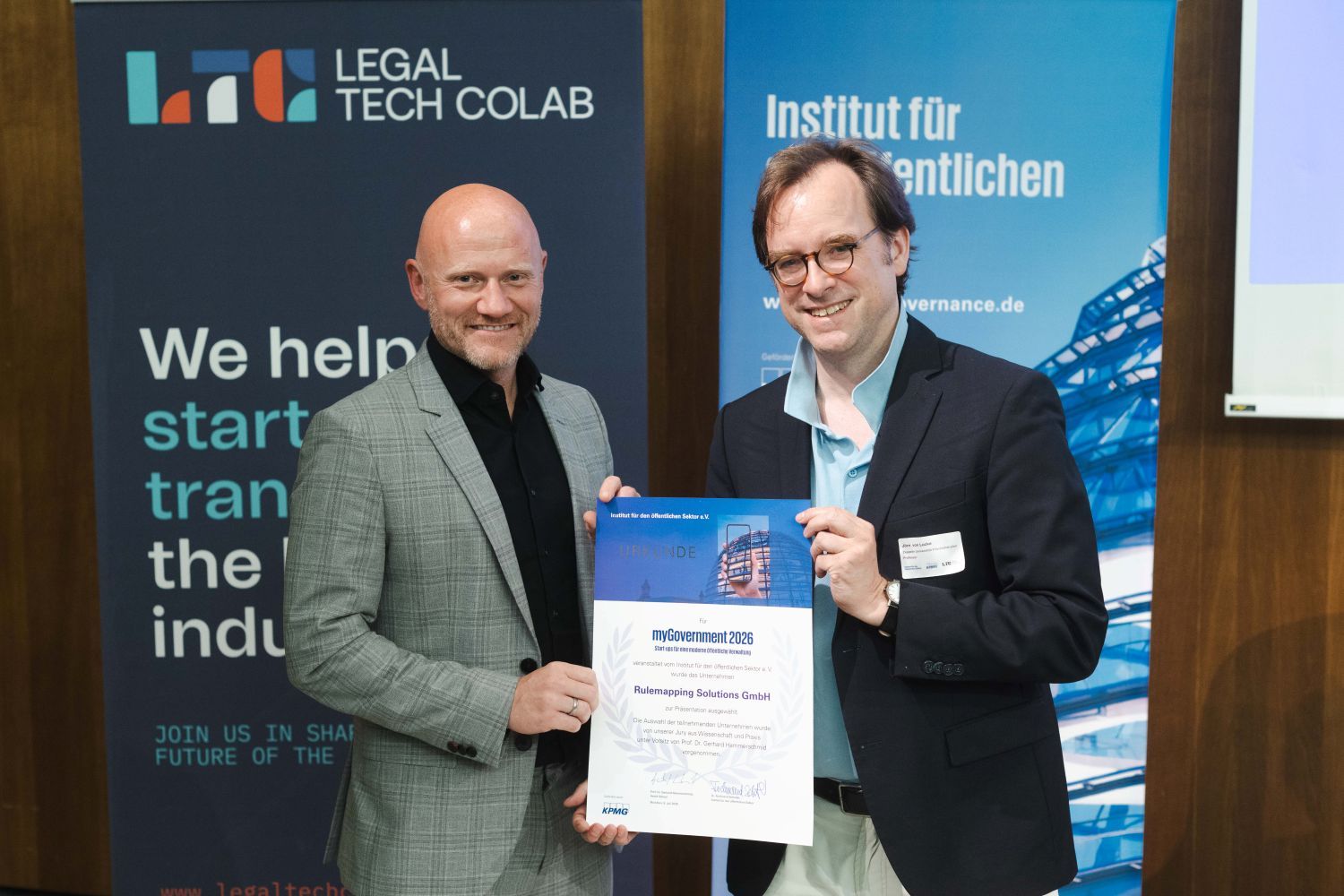
Another highlight: myGovernment 2026 on July 9 at the Munich Urban Colab. A jury led by Prof. Gerhard Hammerschmid selected four startups from across the entire German-speaking GovTech sector. Benjamin Meyer pitched Rulemapping – alongside Verwaltungscloud.SH, kibaudi, and GovRadar – to an audience of about one hundred participants, including decision-makers from government and politics. Bavarian Minister of Justice Georg Eisenreich delivered the opening remarks. What this selection says: Rulemapping is among the solutions the market has been waiting for.
The Legal Community: Infrastructure Requires Trust
Law as Code touches on a question that goes far beyond technology: Who owns the digital infrastructure of the law? Who sets the standards? Who is liable for errors? These are not technical questions – they are questions for the legal profession. That is why the Liquid Legal Summit 2026 at Deloitte Legal in Düsseldorf served as a strategically important platform. Max Senges took the main stage as part of the panel “The Sovereignty Talk” alongside Matthias Schmid from the BMDS, Paula Reichenberg, Jürgen Erbeldinger, and Birgit Hess, moderated by Martin Clemm. The answer that Rulemapping brought to this discussion: open standards, open tools, and government accountability for governance. No lock-in, no black box. An infrastructure that lawyers can trust because it is verifiable.
The General Public: An Infrastructure That Needs to Be Explained
The last – and perhaps most underestimated – group in this coalition is the general public. Law as Code affects everyone, but so far, it has primarily appealed to experts. Changing that is not just a communication challenge. It is a democratic necessity: Anyone building an infrastructure for the rule of law must be able to explain what they are doing and why.
Innokenty Burshteyn did just that in the Re:Form newsletter from ProjectTogether on June 25. His article, “What if our laws were machine-readable?” explains Law as Code and the rule-mapping method to a readership beyond the GovTech bubble – and, using pilot projects on income tax, building permits in Thuringia, and wind power permits in the Neckar-Odenwald district, makes tangible what is at stake. Not as a technical exercise, but as a promise to the people who struggle daily with administrative processes that are too slow and too opaque.
The Coalition Continues to Grow
This work is not yet complete. At the end of September, Rulemapping will be represented at the ITOF 2026 hosted by the Saxon State Chancellery in Dresden – the leading conference on administrative digitization in Saxony, for which Rulemapping was selected as a startup exhibitor. This will be followed in October by the Smart Country Convention at Messe Berlin, the most important forum for the digitization of government and public administration in Germany. Rulemapping will be on site with its own booth at hub27, Booth 210.
Perhaps the most content-rich event of the fall will be the NEGZ Fall Conference 2026 hosted by the National E-Government Competence Center.
There, Rulemapping will co-host a session with Dr. Dirk Woywod, Prof. Dr. Max Senges, and Innokenty Burshteyn: “Law as Code in Practice: From Rule Set to Executable Decision Structure.” The format is intentionally different from a traditional presentation: After a brief introduction, the group will split into two parallel tracks. In the “Law-Coding” track, participants will use their own laptops to model a sample set of rules step by step into an executable verification structure. In the “Standards and Ecosystem” track, participants will discuss which standards, interfaces, and stakeholders are needed for machine-readable law in public administration. At the end, the plenary session will synthesize the results.
This format is no coincidence – it reflects the two levels on which a coalition for Law as Code is built: the practical empowerment of those who model rules, and the strategic understanding of those who shape governance and standards. Both are needed. Both happen here.
You can’t build an infrastructure on your own. But you start by having the right conversations – and then putting the right tools in the right hands. That’s what this fall will be all about. Become part of this coalition – at law-as-code.org.


